
On-Page SEO
E-E-A-T Audit with Claude Code: Check and Fix Signals
Run an E-E-A-T audit with Claude Code: score experience, expertise, authority, and trust on any page, find weak signals, and fix them with concrete steps.
An E-E-A-T audit checks whether a page shows the experience, expertise, authoritativeness, and trust that Google's quality guidelines describe: who made it, how it was made, and why a reader should believe it. With Claude Code, /claudeseo content <url> runs that audit on any page and returns a content quality score, a breakdown of all four E-E-A-T factors, an AI citation readiness score, and a list of specific fixes.
This guide explains what E-E-A-T means in practice, what the command checks, how to run it, and how to fix the weak signals it finds.
Key takeaways
- E-E-A-T isn't a single ranking factor. It describes the qualities Google's systems try to reward, and trust matters most.
- Every audit starts with Google's Who, How, and Why questions before it scores the four E-E-A-T factors.
/claudeseo content <url>also checks content depth against page-type floors, readability, structure, freshness, and markers of low-quality AI content.- Word count minimums are coverage floors, not targets. A short page that fully answers the query is better than a padded one.
- Most fixes are visible and concrete: bylines, author bios, first-hand evidence, cited sources, dates, and contact details.
What is E-E-A-T and why does it matter?
E-E-A-T stands for Experience, Expertise, Authoritativeness, and Trustworthiness. The terms come from Google's Search Quality Rater Guidelines, the handbook human raters use to judge search result quality. Raters don't change rankings directly. Their judgments help Google check whether its ranking systems surface content that people find helpful and reliable.
Google's guide to creating helpful, reliable, people-first content is clear on two points. E-E-A-T itself isn't a specific ranking factor, but Google's systems use a mix of signals that line up with it. And of the four, trust is the most important: the other three contribute to trust, and a page doesn't have to show all of them.
The bar rises with the stakes. Topics that can affect someone's health, finances, safety, or legal situation are called YMYL ("your money or your life"). On a YMYL page, a missing author or an unsourced claim is a serious weakness. On a recipe blog, first-hand experience matters more than formal credentials.
That's why an E-E-A-T audit isn't a checklist you pass once. It asks whether a reader landing on this page, for this topic, would have good reason to trust it.
The Who, How, and Why test
Before scoring anything, the skill runs every page through the three questions from Google's helpful content guidance:
| Question | What the audit looks for |
|---|---|
| Who created it? | A visible byline, an author bio page, and relevant credentials. Expected where readers would look for them, and non-negotiable for YMYL. |
| How was it created? | Process disclosure where readers would reasonably ask, especially for AI-assisted content, plus original research or first-hand evidence. |
| Why does it exist? | To help people, not to attract search clicks. Warning signs include entering a niche without expertise, content churned out for freshness, and pages written to a word count. |
When all three answers are weak, the skill flags the page as at risk under Google's helpfulness signals. The rest of the audit explains why and what to change.
What the /claudeseo content command does
The command is part of the Claude SEO skill suite. It fetches the page, renders JavaScript only when it detects an app shell that needs it, and extracts the main text with navigation, footers, and cookie banners stripped out. That last step matters: author bios and trust signals in the main content get scored without being diluted by site chrome.
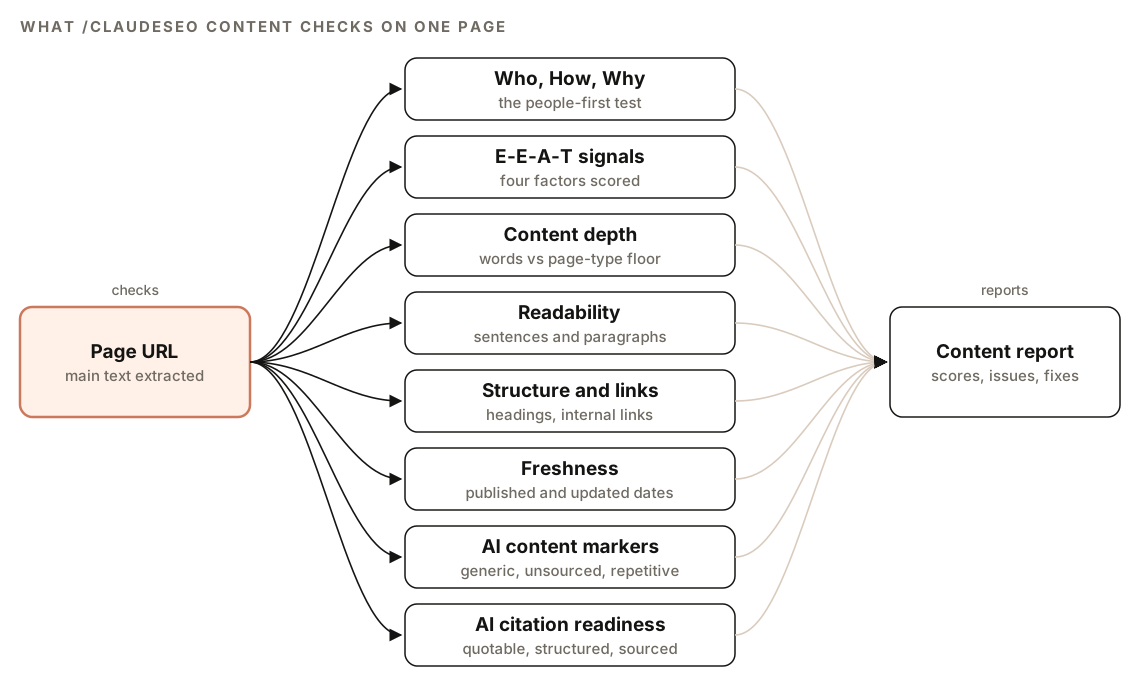
It then checks the page in eight areas:
- Who, How, and Why. Google's people-first test, described above.
- E-E-A-T signals. Evidence for each of the four factors, scored separately.
- Content depth. Word count compared with a minimum for the page type.
- Readability. Sentence length, paragraph length, and reading level for the audience.
- Structure and links. Heading hierarchy, lists, internal links, and outbound citations.
- Freshness. Visible published and updated dates, and stale pages on fast-moving topics.
- AI content markers. Signs of low-quality, mass-produced text.
- AI citation readiness. Whether AI search engines can quote and attribute the page.
The same analysis runs inside a full site audit. When /claudeseo audit runs, the content checks feed the Content Quality category of the report. Our full site audit page explains how the parts fit together.
What an E-E-A-T audit checks
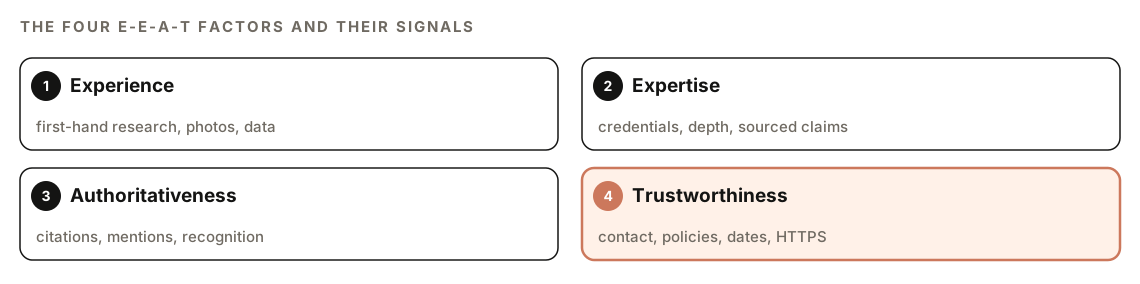
Experience
Experience means the author has done the thing they're writing about. The audit looks for original research, case studies, before-and-after results, personal anecdotes, process documentation, unique data, and photos or videos from direct experience. A product review with the reviewer's own photos shows experience. One that paraphrases the manufacturer's page doesn't.
Expertise
Expertise is the knowledge behind the content. The audit checks for author credentials, certifications, and a bio, a professional background relevant to the topic, technical depth that suits the audience, and accurate, well-sourced claims.
Authoritativeness
Authority is what others say about you. The audit looks for external citations and links from authoritative sources, brand mentions and industry recognition, publication in recognized outlets, and citations by other experts. Much of this lives off the page, so it's the slowest factor to change.
Trustworthiness
Trust signals are the easiest to check and often the quickest to fix: contact information and a physical address, a privacy policy and terms of service, customer testimonials and reviews, date stamps and transparent corrections, and a secure HTTPS connection.
Content depth
The skill compares each page's word count with a minimum for its page type:
| Page type | Minimum words |
|---|---|
| Homepage | 500 |
| Service page | 800 |
| Blog post | 1,500 |
| Product page | 300, or 400 for complex products |
| Location page | 500 to 600 |
The skill is explicit that these are topical coverage floors, not targets. Google's own guidance says it has no preferred word count. A page below the floor is a prompt to check whether it covers the topic fully, not an instruction to pad it.
Readability, structure, and links
For readability, the skill targets a Flesch Reading Ease score of 60 to 70 for a general audience, average sentences of 15 to 20 words, and paragraphs of 2 to 4 sentences, with the grade level matched to the audience. It treats readability as a quality indicator, not a ranking factor to optimize directly.
Structure checks cover a logical H1 to H2 to H3 hierarchy, descriptive headings, lists where they help, and a table of contents on long pages. The primary keyword should appear in the title, the H1, and the first 100 words, used naturally with semantic variations and no stuffing. For links, the skill looks for 3 to 5 relevant internal links per 1,000 words with descriptive anchor text, no orphan pages, and citations to authoritative outside sources.
AI content and AI citation readiness
The skill doesn't penalize AI-assisted writing as such. It treats AI content as acceptable when it shows genuine E-E-A-T, provides unique value, has human oversight and editing, and contains original insight. It flags the markers of low-quality AI content: generic phrasing, no original insight, no first-hand experience, repetitive structure across pages, missing author attribution, and factual errors.
AI citation readiness is a separate score. It checks for clear, quotable statements backed by facts, structured data, a strong heading hierarchy, answer-first formatting for key questions, tables and lists for comparisons, and clear attribution of sources. For the wider topic, see our generative engine optimization guide.
Freshness
The audit checks for a visible publication date and a last-updated date on revised content. On fast-changing topics, it flags pages older than 12 months without an update.
How to run an E-E-A-T audit with Claude Code
Open Claude Code with ClaudeSEO installed and run the command on any public URL:
/claudeseo content https://www.example.com/blog/how-to-choose-a-financial-advisorYou can also ask in plain English, and Claude picks the matching skill:
Run an E-E-A-T audit on https://www.example.com/services/tax-planning. It's a YMYL page, so be strict about author credentials and sources.A few situations change what you get back:
- The URL is unreachable. The skill reports the error and doesn't guess at the content. Check the URL and try again.
- The page is behind a paywall or login. It analyzes only the visible parts, such as meta tags and headers, and notes the limitation.
- Fewer than 100 words come back. It reports what it found, flags the page as possibly JavaScript-rendered or gated, and suggests you paste the full text instead.
If you've connected DataForSEO MCP tools, the audit can add real keyword volume, difficulty, intent classification, and DataForSEO's content analysis. That's optional, it needs a DataForSEO account, and DataForSEO's own pricing applies.
How to read the results
Every report follows the same structure:
### Content Quality Score: XX/100

### E-E-A-T Breakdown
| Factor | Score | Key Signals |
|--------|-------|-------------|
| Experience | XX | [signals found or missing] |
| Expertise | XX | [signals found or missing] |
| Authoritativeness | XX | [signals found or missing] |
| Trustworthiness | XX | [signals found or missing] |

### AI Citation Readiness: XX/100

### Issues Found
### Recommendations
Read the Key Signals column before the scores. It tells you exactly which evidence was found and which was missing, and that's what you'll act on. Then work in this order:
- Weak Who, How, and Why answers. If the page has no visible author, no sign of how it was made, or no clear reason to exist beyond search traffic, fix that first.
- Trust gaps. Missing contact details, policies, dates, or HTTPS undermine everything else, and they're usually quick to fix.
- Experience and expertise. Add first-hand evidence and author credentials. These take more work but separate you from pages that summarize other pages.
- Depth, structure, and readability. Fill coverage gaps, fix heading order, and tighten long paragraphs.
- AI citation readiness. Add answer-first openings, quotable facts with sources, and tables for comparisons.
How to fix common E-E-A-T problems
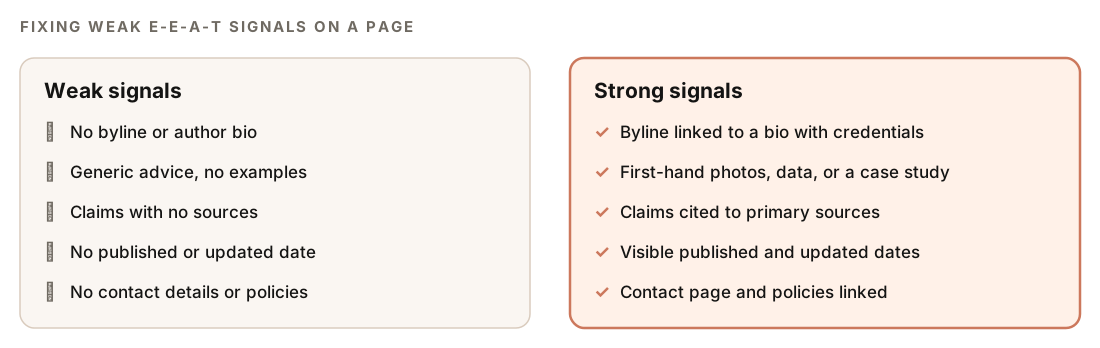
Add a real author. Put a byline on the page that links to an author bio with relevant credentials and background. Then make the author machine-readable. For AI citation readiness, the skill recommends defining brand and author entities with Organization and Person schema:
{
  "@context": "https://schema.org",
  "@type": "Article",
  "headline": "[Article title]",
  "datePublished": "YYYY-MM-DD",
  "dateModified": "YYYY-MM-DD",
  "author": {
    "@type": "Person",
    "name": "[Author name]",
    "url": "https://www.example.com/authors/[author-slug]",
    "jobTitle": "[Role]"
  },
  "publisher": {
    "@type": "Organization",
    "name": "[Company name]",
    "url": "https://www.example.com"
  }
}
Show first-hand experience. Add your own photos, test results, screenshots, or a short case study. One concrete detail from real work does more than a paragraph of general advice.
Cite your claims. Link statistics and factual claims to the primary source, and say when the data was published.
Date your content. Show the published date, and add a last-updated date when you revise the page.
Complete your trust pages. Link the contact page, privacy policy, and terms from every page, usually in the footer.
Once you've reviewed the report, Claude Code can make the on-page changes:
Using the E-E-A-T report for /blog/how-to-choose-a-financial-advisor, add a byline linked to the author page, visible published and updated dates, and Article schema with a Person author. List every unsourced statistic so I can add sources. Show me the diff before saving.For deeper rewrites, /claudeseo flow optimize <url> provides structured prompts for E-E-A-T improvement. If you're writing new content, plan the trust signals before drafting: our guide to the SEO content brief covers the brief's E-E-A-T section, and writing a blog post with Claude Code covers the drafting workflow.
Doing it without the skill
You can run a basic E-E-A-T review with a plain Claude Code prompt:
Fetch [URL] and review only the main content. Answer Google's three questions: who created it (byline, bio, credentials), how it was created (first-hand evidence, process, original data), and why it exists (to help readers or to attract clicks). Then list the signals present and missing for Experience, Expertise, Authoritativeness, and Trustworthiness, including contact details, policies, dates, HTTPS, and cited sources. Flag generic phrasing, unsourced claims, and missing author attribution. End with a prioritized fix list.The skill adds what's hard to keep consistent by hand: main-text extraction, page-type word count floors, readability targets, link density checks, freshness rules, AI content markers, the AI citation readiness score, and the same report format every time, both for single pages and inside a full audit.
E-E-A-T mistakes to avoid
- Treating E-E-A-T as a score to game. Adding a fake-looking bio or a badge doesn't create trust. Real evidence does.
- Padding pages to hit a word count. The floors flag possible coverage gaps. Fill gaps, not space.
- Hiding the author. If readers would expect to know who wrote it, show them, with a bio that explains why they're qualified.
- Publishing AI drafts without editing. Generic phrasing and missing first-hand detail are exactly what the audit flags.
- Forgetting the rest of the site. Contact details, policies, and HTTPS are site-wide trust signals. One missing privacy policy affects every page.
Related guides
- How to run a full SEO audit with Claude Code, which includes content quality across the whole site
- Single-page SEO analysis with Claude Code for a broader check of one URL
- E-E-A-T content analysis, the feature overview
- The full Claude SEO skill list for every command in the suite
FAQ
What is an E-E-A-T audit?
An E-E-A-T audit reviews a page for signs of experience, expertise, authoritativeness, and trustworthiness. It checks who wrote the content and their credentials, whether it shows first-hand evidence, whether claims are sourced, and whether trust basics like contact details, dates, and HTTPS are in place.
Is E-E-A-T a Google ranking factor?
Not directly. Google says E-E-A-T itself isn't a specific ranking factor, but its systems use a mix of signals that identify content with good E-E-A-T. Improving those signals makes content more helpful and trustworthy, which is what the ranking systems aim to reward.
Which part of E-E-A-T matters most?
Trust. Google describes trust as the most important part of E-E-A-T, with experience, expertise, and authoritativeness contributing to it. A page doesn't need to show all four, but it does need to be trustworthy for its topic.
Does AI-generated content hurt E-E-A-T?
Not by itself. The audit treats AI-assisted content as acceptable when it shows genuine E-E-A-T, adds unique value, and has human oversight. It flags the problems that often come with unedited AI text: generic phrasing, no original insight, no first-hand experience, missing authors, and factual errors.
How many words does a page need for good E-E-A-T?
There's no required length. The skill uses coverage floors, such as 800 words for a service page and 1,500 for a blog post, to flag pages that may not cover their topic fully. A shorter page that answers the question completely is better than a padded one.
How do I show experience on a page?
Include evidence only someone who did the work could provide: your own photos or screenshots, test results, measurements, a case study, or a clear description of your process. Pair it with a byline and bio so readers know whose experience it is.