
On-Page SEO
Comparison Pages SEO: Build X vs Y and Alternatives Pages
Build comparison and alternatives pages with Claude Code: pick the page type, build an honest feature matrix, add schema, and keep claims sourced and dated.
Comparison pages SEO is the practice of building "X vs Y", "alternatives to X", and "best tools" pages that rank for people who are close to choosing a product. These searchers want a fair answer, so the pages that earn their trust are accurate, sourced, dated, and honest about where each product is strongest. With Claude Code, the ClaudeSEO /claudeseo competitor-pages command plans these pages for you, from the keyword and feature matrix to the schema and the fairness checks.
This guide covers the four types of comparison page, what makes one trustworthy, how the command works, and how to fix the comparison pages you already have.
Key takeaways
- Comparison searches come from people weighing a decision, so accuracy and balance matter more here than on most page types.
- The skill covers four page types: X vs Y, alternatives, best tools roundups, and comparison tables, each with its own keyword pattern.
- Every competitor claim should be verifiable from public sources, linked where possible, and every price marked "as of [date]".
/claudeseo competitor-pages [url|generate]produces a page outline, a feature matrix, JSON-LD schema, a keyword strategy, and recommendations.- When data isn't available, the skill writes "Not publicly available" instead of guessing.
What are comparison pages and why do they matter for SEO?
A comparison page helps someone choose between products or services. The searcher has usually done their early research already. They know the category, they have two or three names in mind, and they want to know which one fits them. That makes them high-intent searches, and commercially valuable ones.
It also makes them some of the easiest pages to get wrong. When you compare your own product against others, every reader knows you have a stake in the answer. A page that hides competitor strengths, quotes old prices, or makes claims with no source reads as an advert. A page that is open about its affiliation, shows its method, and gives credit where it's due is one people actually use to decide.
The four comparison page types
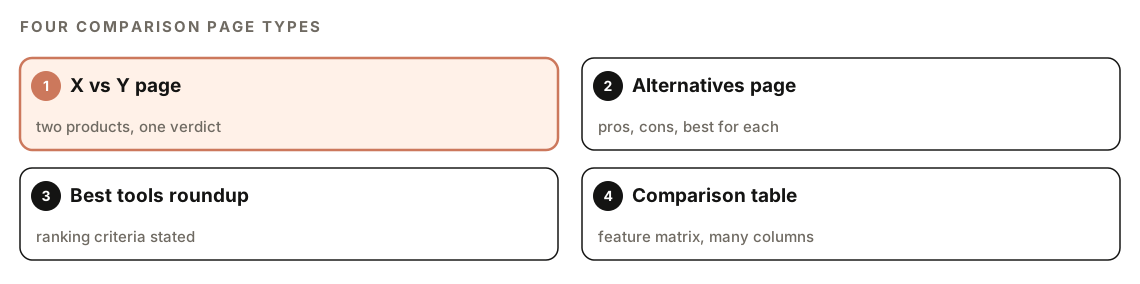
The skill plans four kinds of page, each matched to a keyword pattern:
| Page type | What it contains | Target keyword pattern |
|---|---|---|
| X vs Y | A balanced feature-by-feature comparison of two products and a clear verdict with reasons | [Product A] vs [Product B] |
| Alternatives | A list of alternatives, each with a short summary, pros and cons, and who it's best for | [Product] alternatives, best alternatives to [Product] |
| Best tools roundup | A curated list of tools in a category, with the ranking criteria stated | best [category] tools [year], top [category] software |
| Comparison table | A feature matrix with several products in columns, sortable if interactive | [category] comparison, [category] comparison chart |
The skill's keyword patterns also include longer comparison searches: [A] vs [B] for [use case], [A] vs [B] pricing, [A] review [year], and is [A] better than [B].
What the /claudeseo competitor-pages command does
The command is part of the Claude SEO skill suite. Give it the URL of an existing comparison page to review, or use generate to plan a new one. The work covers these stages:
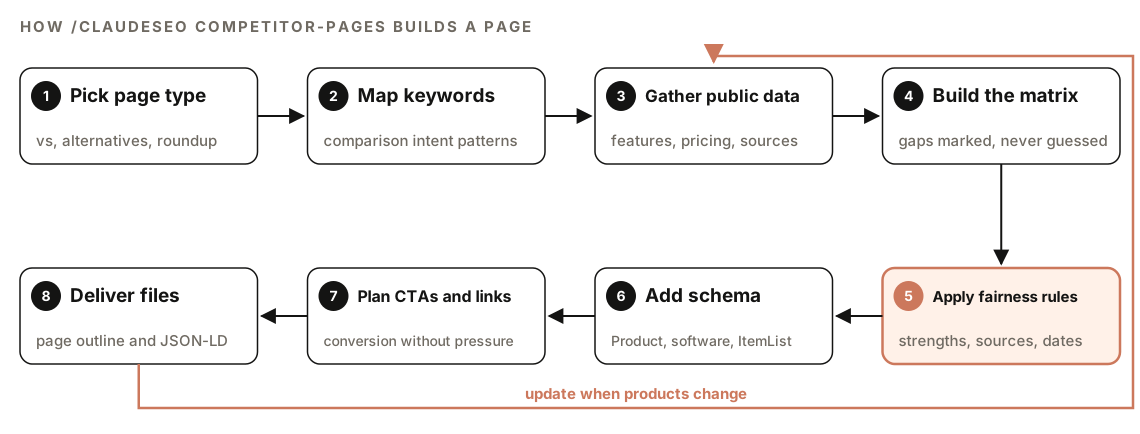
- Pick the page type. X vs Y, alternatives, roundup, or comparison table, based on the search you're targeting.
- Map keywords. Primary and secondary keywords, related long-tail opportunities, and content gaps compared with existing comparison pages.
- Gather public data. Features and pricing from public sources, with a source link for each competitor data point where possible.
- Build the matrix. A feature table with your product and each competitor in columns. Missing data is labeled, not guessed.
- Apply fairness rules. Strengths acknowledged, affiliation disclosed, prices dated, no false or misleading claims.
- Add schema. Product, SoftwareApplication, or ItemList JSON-LD, depending on the page.
- Plan CTAs and links. Calls to action placed where they help rather than pressure, plus internal links and breadcrumbs.
- Deliver the files. A ready-to-implement page structure, the schema file, the keyword strategy, and recommendations.
Comparison data goes stale. The skill recommends reviewing each page quarterly, or sooner when a competitor ships a major change.
What a strong comparison page includes
A feature matrix with honest gaps
The matrix is the core of most comparison pages. The skill's layout puts features in rows and products in columns, marks partial support as partial, and adds a pricing row with a date:
| Feature | Your product | Tool A | Tool B |
|---|---|---|---|
| [Feature 1] | Yes | Yes | No |
| [Feature 2] | Yes | Partial | Yes |
| [Feature 3] | Yes | No | Not publicly available |
| Starting price | [price] as of [date] | [price] as of [date] | [price] as of [date] |
Notice the last cell in the third row. When a competitor's pricing or features can't be found, the skill flags the gap and writes "Not publicly available" rather than guessing. A blank or a guess is worse than an honest gap, because one wrong cell makes readers doubt every other cell.
Data you can defend
The skill's accuracy requirements are short and strict:
- Every feature claim must be verifiable from public sources.
- Pricing must be current and carry an "as of [date]" note.
- Each competitor data point should link to its source where possible.
- Competitor features should be tested where possible, and documented from the competitor's own materials otherwise.
Titles and headings that match the search
The skill's title formulas follow the shape of each search:
X vs Y:     [A] vs [B]: [Key Differentiator] ([Year])
Roundup:    [N] Best [Category] Tools in [Year], Compared & Ranked
Alternatives pages follow the same idea: the number of alternatives, the product name, and the year. The H1 should match the title's intent, include the primary keyword naturally, and stay under 70 characters. Our guide to title tags and meta descriptions with Claude Code covers the wider rules.
Schema markup for each page type
The skill recommends structured data that fits the page, delivered as comparison-schema.json. Software comparisons use SoftwareApplication:
{
  "@context": "https://schema.org",
  "@type": "SoftwareApplication",
  "name": "[Software Name]",
  "applicationCategory": "[Category]",
  "operatingSystem": "[OS]",
  "offers": {
    "@type": "Offer",
    "price": "[Price]",
    "priceCurrency": "USD"
  }
}
Roundup pages use ItemList, with one ListItem per product in ranked order:
{
  "@context": "https://schema.org",
  "@type": "ItemList",
  "name": "Best [Category] Tools [Year]",
  "itemListOrder": "https://schema.org/ItemListOrderDescending",
  "numberOfItems": "[Count]",
  "itemListElement": [
    { "@type": "ListItem", "position": 1, "name": "[Product Name]", "url": "[Product URL]" }
  ]
}
For other products, the skill's Product template includes a brand and an AggregateRating. Only mark up ratings that genuinely exist and are shown on the page, and check them against Google's review snippet guidelines before you ship. Test the final markup in the Rich Results Test. The schema markup feature and our schema markup guide cover validation in depth.
A layout that converts without pushing
The skill places calls to action in three spots: a short comparison summary with the main CTA near the top, a CTA right after the comparison table, and a final recommendation with a CTA at the bottom. It specifically advises against aggressive CTAs inside the sections that describe competitors, because they reduce trust.
Around those, it plans:
- Social proof: testimonials relevant to the comparison criteria, third-party review ratings with source links, and real migration stories from customers who switched.
- Pricing highlights: a clear pricing table that shows value, not just the lowest price, including hidden costs such as setup fees, per-user pricing, and overage charges, plus a link to your full pricing page.
- Trust signals: a "Last updated [date]" stamp, an author with relevant expertise, a short note on how the comparison was done, and a clear statement of which product is yours.
Internal links between comparisons
Comparison pages work best as a connected set. The skill links from comparison sections to your own product and feature pages, cross-links related comparisons (an "A vs B" page links to "A vs C"), adds a related comparisons section at the bottom, and uses a breadcrumb trail of Home, then Comparisons, then the page itself. Our internal linking guide covers the wider strategy.
How do you keep comparison pages fair and accurate?
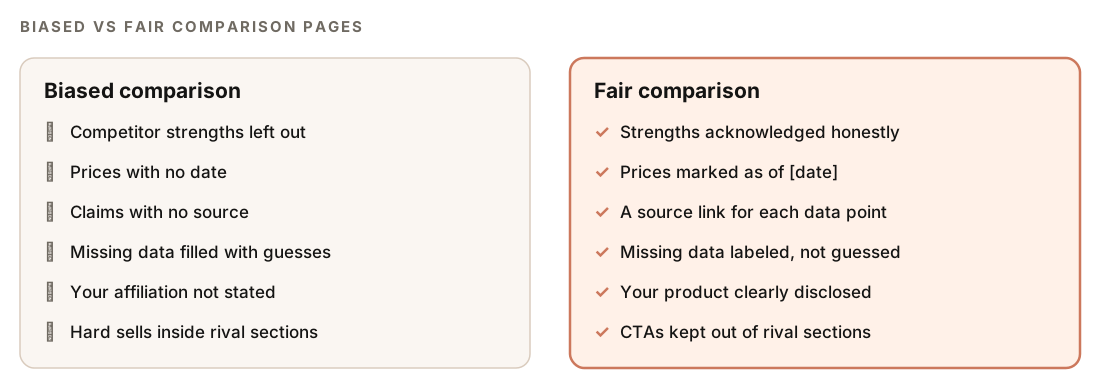
Fairness isn't a nice extra on a comparison page. It's the reason the page works. The skill's fairness guidelines are:
- Accuracy: every competitor fact is verifiable from public sources.
- No defamation: never make false or misleading claims about a competitor.
- Cite sources: link to competitor websites, review sites, or documentation.
- Timely updates: review the page when competitors release major changes.
- Disclose affiliation: state clearly which product is yours.
- Balanced presentation: acknowledge competitor strengths honestly.
- Pricing accuracy: put an "as of [date]" note on all pricing data.
- Feature verification: test competitor features where possible, and cite documentation otherwise.
A useful habit: if a competitor is genuinely better for some readers, say so and say who. "Tool A is the better fit if you need [specific capability]" costs you very little, and it makes the rest of your verdict believable. They overlap with what the E-E-A-T content checks look for: first-hand experience, author credentials, date stamps, and well-sourced claims.
How to run it
Open your project in Claude Code with ClaudeSEO installed. To review an existing comparison page:
/claudeseo competitor-pages https://www.example.com/compare/your-product-vs-tool-a/To plan a new page:
/claudeseo competitor-pages generateOr describe the job in plain English:
Create an alternatives page for people searching "[Tool A] alternatives". Include our product and three others, with a feature matrix, pros and cons, best-for notes, dated pricing, and ItemList schema. Mark anything you can't verify as "Not publicly available".The skill file doesn't list a third-party API key or account requirement.
How to read the output
The command returns four parts:
### Comparison Page Template
COMPARISON-PAGE.md: page structure with sections
Feature matrix table
Content outline with word count targets (minimum 1,500 words)

### Schema Markup
comparison-schema.json: Product / SoftwareApplication / ItemList JSON-LD

### Keyword Strategy
Primary and secondary keywords
Related long-tail opportunities
Content gaps vs existing competitor pages

### Recommendations
Content improvements, new page opportunities, schema additions, conversion suggestions
Start with the feature matrix. Check every competitor cell against its source yourself before anything else; that's the part with legal and reputational weight. Then review the outline, the schema, and the recommendations.
The skill also reports when it hits problems. If a competitor's site can't be reached, it says which URLs failed, continues with the data it has, and notes the gaps. If the products you named don't really overlap, it says they serve different markets and suggests competitors that do share features, or suggests switching to a category roundup.
How to fix common problems on existing comparison pages
Stale pricing. Replace every undated price with a current one and an "as of [date]" note, and put a "Last updated [date]" stamp near the top.
Unsourced claims. Add a link to the competitor's documentation, pricing page, or a review site for each claim. If you can't find a source, rewrite the claim or remove it.
No disclosure. Add one sentence near the top stating which product is yours and how you did the comparison.
One-sided verdicts. Add an honest "where Tool A is stronger" section and a "best for" line for each product.
Thin alternatives pages at scale. A page per competitor with no real comparison data is a pattern that causes trouble. Our guide to programmatic SEO without thin pages explains why.
Then hand the fixes to Claude Code:
Using the competitor-pages recommendations, update /compare/your-product-vs-tool-a. Add "as of [date]" to every price, link a source for each competitor claim, add an affiliation note and a "where Tool A is stronger" section, and move CTAs out of the competitor sections. Show me the diff first.Doing it without the skill
You can plan a solid comparison page with plain Claude Code prompts:
I'm writing "[Your product] vs [Tool A]". From public sources only, build a feature matrix with one row per feature and a source URL for every competitor cell. Use "Not publicly available" where you can't confirm something. Then list where each product is genuinely stronger, and draft a verdict that says who should pick which.And to audit a page you already have:
Review this comparison page: [URL]. Flag any competitor claim without a source, any price without a date, any missing affiliation disclosure, and any CTA inside a competitor section. Suggest a title in the form "[A] vs [B]: [Key Differentiator] ([Year])" and an H1 under 70 characters.The skill adds the full structure in one pass: page type selection, keyword strategy with content gaps, a fairness checklist, schema files, conversion layout, linking, and consistent handling of missing data.
Comparison page mistakes to avoid
- Guessing to fill a table. "Not publicly available" is honest. A guessed "No" in a competitor's column is a false claim.
- Undated prices. Prices change. Without a date, a correct price becomes a wrong one without anyone noticing.
- Hiding your affiliation. Readers can tell whose site they're on. Saying so plainly builds trust.
- Selling inside the competitor sections. Keep CTAs in the summary, after the table, and at the end.
- Never updating. Review quarterly, and sooner when a competitor ships something major.
- Ratings markup you can't back up. Only mark up ratings that exist and appear on the page.
Related guides
- Schema markup with Claude Code for validating Product, SoftwareApplication, and ItemList JSON-LD
- Title tags and meta descriptions with Claude Code for comparison titles that earn the click
- Programmatic SEO with Claude Code if you're planning many comparison pages from one template
- Install SEO skills in Claude Code to set up the command
FAQ
Are comparison pages good for SEO?
Yes, when they're genuinely useful. Comparison searches come from people close to a decision, so a fair, well-sourced page can rank and convert. A one-sided page reads as an advert, which undercuts both goals.
Can I mention competitor names on my comparison pages?
Comparison pages name other products by nature. Keep every claim accurate, sourced, and dated, never make false or misleading statements, and say clearly which product is yours. If you're unsure about trademark or advertising rules in your market, check with a lawyer.
How often should I update a comparison page?
The skill recommends a review every quarter, and an update whenever a competitor ships a major change. Show a "Last updated [date]" stamp so readers know how current the page is.
What schema should a comparison page use?
It depends on the page type. The skill recommends SoftwareApplication for software comparisons, ItemList for roundups, and Product with a brand and rating for other products. Validate the result with the Rich Results Test, and only mark up ratings that genuinely appear on the page.
What's the difference between a vs page and an alternatives page?
A vs page compares two products head to head and ends with a verdict. An alternatives page lists several options for people who are leaving or ruling out one product, with pros, cons, and a best-for note for each.
How long should a comparison page be?
The skill's page outlines target at least 1,500 words, with word count targets per section. Length follows from coverage: a complete feature matrix, honest pros and cons, dated pricing, and a clear verdict usually need that much room.