
Content Operations
Editorial Calendar and Blog Strategy with Claude Code
Plan a blog strategy and editorial calendar with Claude Code: pillars, topic clusters, a 60/30/10 content mix, refresh queues, and distribution timing.
An editorial calendar is a dated plan of what your blog will publish, refresh, and repurpose each week, and which topic each piece supports. It works best on top of a strategy that decides who you write for and which topics you want to own. In Claude Code, /claudeblog strategy <niche> builds that strategy and /claudeblog calendar [period] turns it into a monthly or quarterly calendar.
This guide explains how to plan a blog strategy and an editorial calendar, what each ClaudeSEO command produces, how to run them, and how to keep the plan current.
Key takeaways
- Strategy decides what the blog is for and which topics it should own. The editorial calendar decides what ships each week.
/claudeblog strategy <niche>maps audiences, competitors, 3 to 5 content pillars with hub-and-spoke clusters, quality targets, and a 90-day roadmap./claudeblog calendar [period]builds a monthly or quarterly plan with a 60/30/10 mix of new posts, refreshes, and repurposed pieces.- The calendar finishes clusters before starting new ones and never has more than 3 clusters in active build-out at once.
- Important posts get a next refresh date, and every new post gets a distribution schedule.
What is an editorial calendar, and why start with a strategy?
An editorial calendar is a schedule for content. Each entry has a date, a title, and a status, and a useful one adds the target keyword, the topic cluster, the format, and an owner. It also schedules work on posts you already have, because updating a proven post can be worth more than writing a new one.
The calendar answers "what do we publish next Tuesday?" It can't answer "why this topic and not another?" That's the job of the blog strategy, which sets:
- Goals. Traffic, leads, authority, or citations in AI answers.
- Audience. Who reads the blog, what they search for, and how close they are to buying.
- Content pillars. The handful of broad topics you want to be known for.
- Standards. What every post must include before it goes live.
Without a strategy, calendars fill up with whatever came to mind that week: posts that don't link to each other, don't add up to authority, and sometimes chase the same keyword. With a strategy, every slot has a reason: it fills a gap in a cluster, refreshes a post that matters, or lands ahead of a seasonal peak.
Topic clusters connect the two
Both commands plan around topic clusters. A cluster is one pillar page, a broad guide to the main topic, plus spoke posts that each cover a narrower subtopic and target a long-tail keyword (a longer, more specific search phrase). The pillar and spokes link to each other, which shows readers and search engines that the blog covers the subject fully. Our guide to keyword clustering and topic clusters explains how to group keywords into clusters using search results.
How do the strategy and calendar commands work together?
Both commands are part of the Claude Blog skill suite. Strategy comes first and runs rarely: at the start, then again when your business or audience changes. The calendar runs every month or quarter, and running it for the first month is the strategy's own next step.
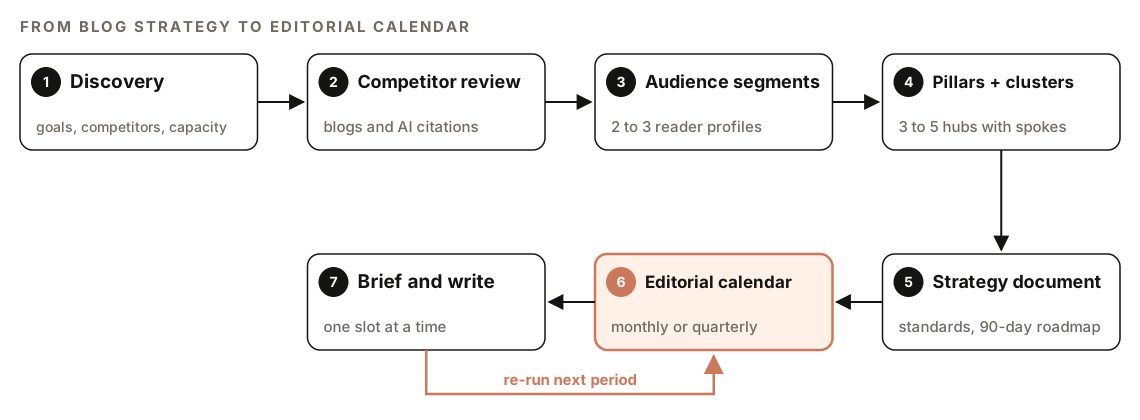
- Discovery. The strategy command asks about your business, customers, blog goals, 3 to 5 main competitors, unique expertise or data, and writing capacity. It scans any existing blog content in the project.
- Competitor review. It researches competitor blogs: publishing frequency, content types, visuals, schema use, social distribution, and whether AI assistants cite them.
- Audience segments. It defines 2 to 3 reader segments, each with pain points, search and AI behavior, and buying stage.
- Pillars and clusters. It designs 3 to 5 pillars and a hub-and-spoke cluster for each.
- Strategy document. It writes everything into one document, including a 90-day roadmap.
- Editorial calendar. The calendar command turns the plan into dated slots, adds refreshes and seasonal hooks, and schedules distribution.
- Brief and write. Each slot becomes a brief, then a post. Next period, you re-run the calendar.
The strategy also plans for the five places people find content in the FLOW framework: your site, search results including AI Overviews, AI assistant citations, the local pack (handed to the Claude SEO suite), and communities and video. For deeper research first, run /claudeblog flow find. If a DISCOURSE.md file from /claudeblog discourse <topic> exists at your project root, the strategy loads it too.
What does /claudeblog strategy produce?
The output is a strategy document with a fixed set of sections:
| Section | What it contains |
|---|---|
| Audience | 2 to 3 segment profiles |
| Pillars and clusters | Spokes, links, and templates per pillar |
| Competitive positioning | How you differ, plus AI citation gaps |
| AI citation strategy | On-site structure and off-site channels |
| Quality standards | Targets every post must meet |
| Distribution and velocity | Channels, posts per week, refreshes per month |
| 90-day roadmap | A checklist for each month |
| Measurement | SEO, AI citation, quality, and business metrics |
Pillars and hub-and-spoke clusters
For each pillar, the command lists 3 to 5 primary keywords, a unique angle based on your first-hand experience or data, an estimated post count, and its AI citation potential. Each pillar gets 8 to 12 spoke topics.
Every piece is assigned one of 12 content templates: how-to guide, listicle, case study, comparison, pillar page, product review, thought leadership, roundup, tutorial, news analysis, data research, and FAQ. The cluster build plan has one row per post with its template, target keyword, word count, and the posts it should link to.
Competitive AI citation map
Using web search, the command checks which sources ChatGPT, Perplexity, and Google AI Overviews cite for your target queries and rates each competitor's AI visibility as High, Medium, Low, or None. Queries where no competitor is cited are marked as the best openings for new content.
Quality standards
The strategy sets targets every post must meet before it's published:
| Standard | The skill's target |
|---|---|
| Quality score | 80 or higher with /claudeblog analyze |
| E-E-A-T | Named author and 8+ tier 1 to 3 sources |
| AI citation readiness | Answer-first sections, FAQ, citation capsules |
| Visuals | 2+ charts and 3+ images per post |
| Internal links | 5+ per post, within the cluster |
| Schema | Article, FAQ, and any relevant type |
| Length | 1,500+ words for spokes, 3,000+ for pillars |
Posts that score below 80 should be revised before they go live. Our guide to scoring a blog post before publishing explains how that score works.
It also plans how to show first-hand experience, through original data, case studies, expert interviews, and hands-on reviews.
What does /claudeblog calendar include?
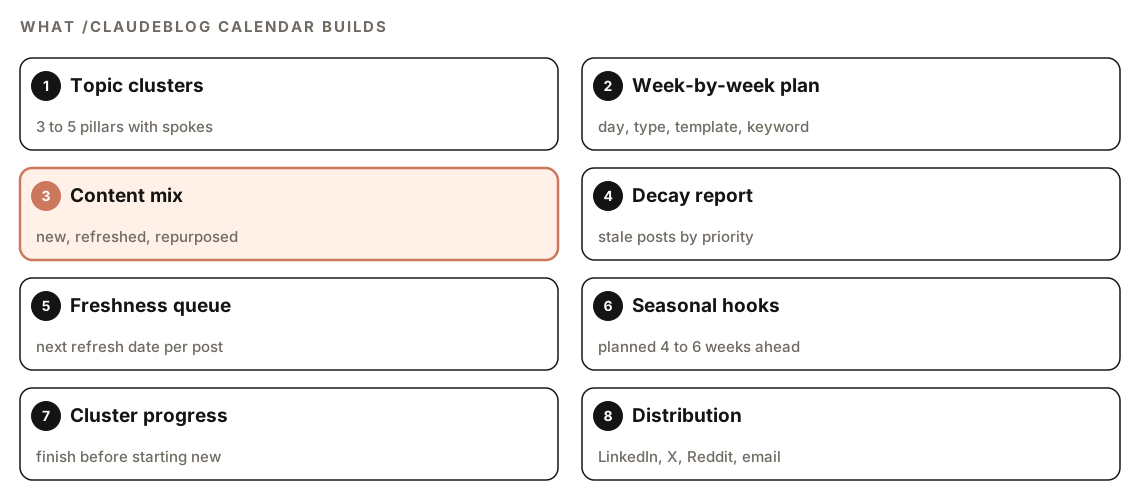
The calendar asks about your niche, cadence, timeframe (monthly or quarterly), and business goals, and scans the project for existing Markdown, MDX, or HTML posts. Without a cadence, it plans for two posts a week. It designs 3 to 5 clusters, each with a pillar of 3,000+ words plus supporting guides, comparisons, and FAQ posts.
Content mix
Each month is split between new content, freshness updates, and repurposed content using a fixed ratio.
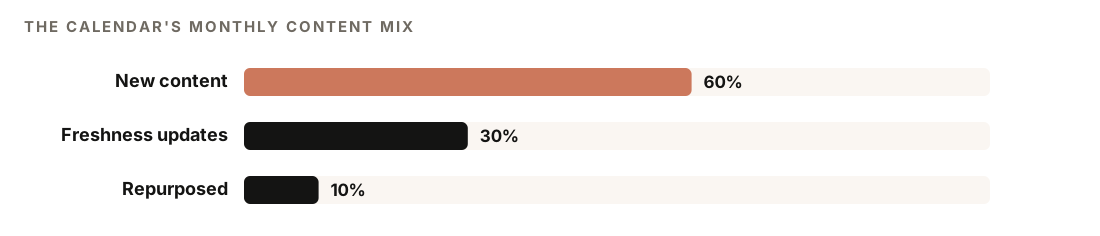
| Cadence | Posts a month | New | Refreshes | Repurposed |
|---|---|---|---|---|
| 1 post a week | 4 | 2 to 3 | 1 | 0 to 1 |
| 2 posts a week | 8 | 5 | 2 | 1 |
| 3 posts a week | 12 | 7 | 4 | 1 |
| 4 posts a week | 16 | 10 | 5 | 1 |
New posts are spread across formats, with guides and how-tos the largest share (30 to 40%), followed by comparisons, listicles, case studies, and thought leadership. Each new post gets a recommended template from the same 12.
Freshness queue and decay check
The calendar reads the lastUpdated or date field in each post's frontmatter and flags stale posts, holding high-traffic posts to the strictest thresholds. High-priority posts are scheduled for an update every 30 days and medium-priority posts every 90 days; evergreen posts are updated when their data changes. Each queued post gets a next refresh date, a priority, and an owner. Our guide to detecting content decay with Search Console covers the thresholds and how to combine them with traffic data.
Seasonal hooks
The calendar looks for industry events, seasonal search trends, annual report releases in your niche, and Google algorithm updates. It schedules seasonal content 4 to 6 weeks before the peak so pages have time to be indexed, and it uses web search to confirm trend timing first.
Cluster progress rules
The calendar tracks each cluster's coverage and applies four rules:
- Clusters at 50% coverage or more get the highest priority.
- Clusters with a published pillar but few spokes come second.
- New clusters start only when existing ones reach 75% coverage.
- No more than 3 clusters are in active build-out at the same time.
Distribution schedule
Every new post gets channel timing: LinkedIn and X on publish day, Reddit 2 to 3 days later with a genuine insight rather than a bare link, a weekly email newsletter with 2 to 3 posts, and a YouTube video for pillar posts only. Our guide to repurposing blog content for X, LinkedIn, and email covers creating those formats.
How to run a blog strategy and editorial calendar
Open your blog project in Claude Code with Claude Blog installed. Run the strategy first and pass your niche:
/claudeblog strategy home espresso equipmentAnswer the discovery questions, or include the answers in your first message so it can start right away. Then generate a monthly or quarterly calendar:
/claudeblog calendar monthly
/claudeblog calendar quarterly
You can also ask in plain English, and Claude picks the matching skill:
Build a quarterly editorial calendar for this blog at three posts a week, using the pillars from our strategy document, and put the most outdated high-traffic posts at the top of the refresh queue.Both commands use web search: the strategy for competitor and AI citation research, the calendar for seasonal timing. Run them in the same session so Claude can carry the strategy's pillars into the calendar.
How to read the editorial calendar
A monthly calendar follows this format:
## Editorial Calendar: [Month Year]

Publishing Cadence: [N] posts/week
Content Mix: [N] new / [N] refreshes / [N] repurposed

### Week 1: [Date Range]
| Day | Type | Title | Template | Cluster | Target Keyword | Status |
|-----|------|-------|----------|---------|----------------|--------|
| Mon | New | [Title] | how-to-guide | [Cluster] | [keyword] | Draft |
| Thu | Update | [Existing post] | - | [Cluster] | [keyword] | Refresh |

## Content Mix This Month
## Freshness Update Queue
| Post | Last Updated | Priority | Scheduled |
## Seasonal Hooks
Alongside it come the cluster progress table and the distribution schedule. A quarterly plan summarizes active clusters and planned actions, gives each month a focus cluster and a weekly table, and ends with a checklist of quarterly goals.
When you review it, check three things. Every new post should belong to a cluster and have a target keyword no other row shares. Refreshes should be spread through the period, not bunched at the end. And Critical decay items come first: the skill's guidance is to review that report weekly.
Then work through the slots. Create a brief for the first topic with /claudeblog brief <topic> (see our guide to creating an SEO content brief), write it with /claudeblog write <topic>, handle refreshes with /claudeblog rewrite <file>, and re-run the calendar next period. The editorial workflow page shows how these commands fit together.
Doing it without the skill
You can plan a basic strategy and calendar with plain Claude Code prompts. Start with the clusters:
I run a blog about [niche] for [audience]. Our goal is [traffic, leads, or authority] and we can publish [N] posts a week. Propose 3 to 5 content pillars. For each, list a pillar page and 8 to 12 spoke topics, each with one long-tail target keyword, a format (how-to, comparison, listicle, case study), and the other posts in the cluster it should link to. Flag any two topics that would target the same keyword.Then turn them into a schedule:
Read the date or lastUpdated field in the frontmatter of every post in ./content. Build a four-week editorial calendar at two posts a week: new posts that fill gaps in the clusters above, two refreshes of the posts updated longest ago, and one repurposed piece. Output one table per week with day, type, title, cluster, target keyword, and status.The skill adds what's tedious to repeat: competitor and AI citation research, quality targets tied to the scoring command, staleness thresholds by traffic level, cluster progress rules, and distribution timing, applied the same way every period.
Editorial calendar mistakes to avoid
- Planning only new posts. Without refreshes, older posts decay unnoticed.
- Starting too many clusters. Several half-built clusters build less authority than a few complete ones.
- Skipping the links. Add the planned cluster links when each post ships.
- Ignoring capacity. A cadence you can't sustain falls apart in the first month.
- Publishing seasonal posts at the peak. Schedule them weeks ahead so they're indexed in time.
- Never revisiting the strategy. Re-run it when your goals or audience change.
Related guides
- Keyword clustering and topic clusters with Claude Code
- Detect content decay with Search Console and Claude Code
- How to create an SEO content brief with Claude Code
- The full Claude Blog skill list
FAQ
What is the difference between a content strategy and an editorial calendar?
A content strategy sets direction: goals, audience, the topics you want to own, and quality standards. An editorial calendar is the schedule that carries it out, with dates, titles, keywords, and owners. The strategy changes rarely; the calendar is rebuilt every month or quarter.
How far ahead should you plan an editorial calendar?
A month or a quarter is a practical horizon, and those are the two periods /claudeblog calendar supports. A month is easier to keep accurate. A quarter suits finishing a cluster and seasonal content, which the calendar schedules 4 to 6 weeks before the peak.
How many blog posts should you publish per week?
As many as you can sustain at full quality. The calendar assumes two posts a week if you don't set a cadence, and its content mix covers one to four posts a week. A steady pace you keep beats an ambitious one you abandon.
What should an editorial calendar include?
Each entry needs a date, a type (new, update, or repurposed), a title, a target keyword, a cluster, and a status. A complete calendar also has a refresh queue, seasonal hooks, cluster progress, and a distribution plan for new posts.
How often should you update old blog posts?
It depends on how much traffic a post brings in. The calendar schedules high-priority posts for an update every 30 days and medium-priority posts every 90 days. Only change the update date when the content has changed in a meaningful way.
Can Claude Code build an editorial calendar from my existing posts?
Yes. The calendar command scans your project for Markdown, MDX, and HTML posts, reads their update dates, and queues stale posts for refreshes next to new topics. The strategy command also scans existing content during discovery.